
MEET THE FOUNDER
A liberal arts seminar.
Designed for children.
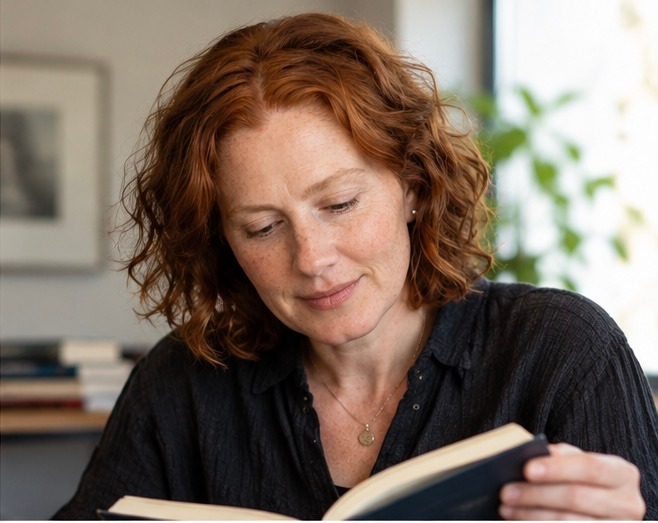
Dr. Maria Frisch
Behavioral scientist · Founder, Hawthorne Institute
My work has brought together two perspectives that shape everything I am building at Hawthorne: the study of how children develop and the practice of teaching in a liberal arts classroom.
I hold a PhD in Psychology, with experience spanning child and adolescent development, clinical research, and more than a decade of teaching in liberal arts college settings. Across that work, I have become especially interested in a question: How can we offer children substantial intellectual depth while designing thoughtfully for their stage of life?
The question that became Hawthorne
In a great seminar, understanding develops through conversation. Someone notices a detail. Another offers a competing interpretation. An assumption comes into view, and the group returns to the text to examine it. Learning involves explaining a position, listening closely, and deciding whether a new perspective changes your own.
I wanted to create that kind of experience for younger scholars, with the books, questions, expectations, and guidance considered from the beginning through the lens of childhood.
A child may be ready to explore a difficult philosophical question while still needing help entering a discussion, navigating disagreement, or making sense of an emotionally demanding story. Intellectual readiness tells us something important about the challenge to offer. Understanding the individual child helps us consider the support.
That distinction became a founding principle of Hawthorne.
What that means at the seminar table
At Hawthorne, literature provides a shared starting point for inquiry across philosophy, history, science, and human experience. A story’s unreliable narrator can lead to questions about evidence. A community’s conflict can open a discussion about fairness, responsibility, or how beliefs spread.
Small seminars give those questions room to develop. Scholars are invited to explain their reasoning, consider alternatives, and revisit an idea as the conversation unfolds.
Developmental care shapes the details: considering a book’s emotional demands alongside its conceptual possibilities; allowing time to think before responding; and exploring difficult experiences through fictional characters without requiring children to disclose their own.
These choices are central to the education I want Hawthorne to offer. They make room for ambitious thinking, imaginative exploration, and the support children need to participate.
The responsibility behind the wonder
My research background also shapes how I approach Hawthorne’s claims and commitments. Research should inform educational design, and we should be clear about what it establishes.
The Hawthorne Standard guides our choices about literature, developmental readiness, inquiry, discussion, and reflection. It also asks us to distinguish research findings from the educational judgments we make in applying them.
It is a framework for thoughtful design and ongoing improvement. Hawthorne’s educational outcomes have not been independently validated.
For me, that responsibility belongs alongside the pleasure of a remarkable book and an absorbing conversation. I want scholars to leave with an interpretation they can explain, a perspective they had not considered, or a question they want to pursue—and the confidence that they can contribute while still having much to discover.

Dr. Maria FrischFounder, Hawthorne Institute