HAWTHORNE / ACTIVITY PREVIEWBack to website review ↗
Skip to content

A MOMENT OF HAWTHORNE INQUIRY

What can we know
from a scene?

Look closely. A small detail can open a much larger question.

Choose a detail, consider more than one explanation, and ask what would help you decide.

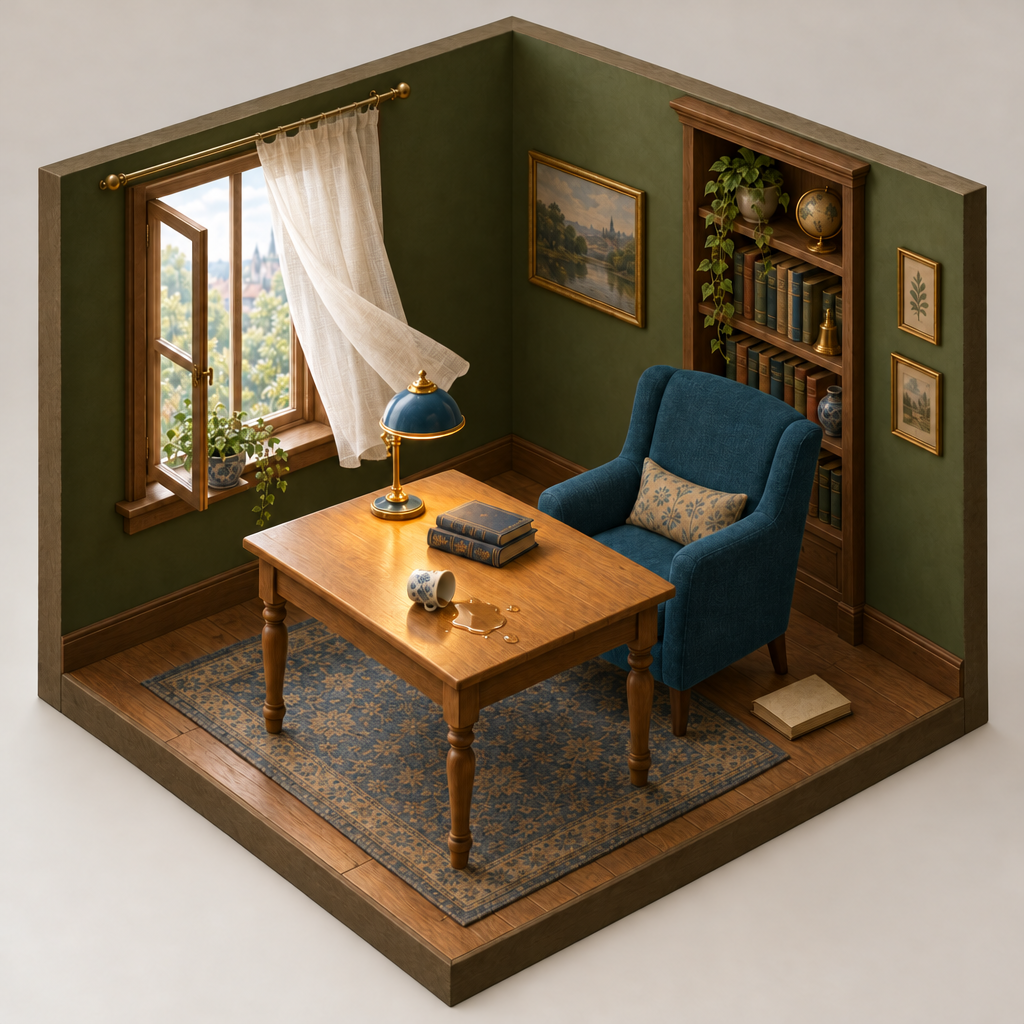
An imagined reading room with an open window and curved curtain, a tipped cup beside liquid on a wooden table, and a book on the floor by a blue armchair.
An original visual scenario. Explore the possibilities.

The open window

Observe

What can you
point to?

Describe this detail before explaining it. Which words belong to the picture itself?

Compare your observations

One window panel is open. A pale curtain curves into the room beside it. A leafy plant sits on the wooden sill.

Interpret

What else
could explain it?

The curtain’s shape is visible. What shaped it is uncertain.

Consider another explanation

Someone might have arranged the curtain and secured it with a tie outside our view.

Test

What would
help us decide?

A view behind the curtain could reveal a tie or clip. Watching its shape as the window opens and closes could help us investigate airflow. Could both explanations play a part?

A facilitator might ask

“Which words describe the picture, and which add an explanation we have not checked?”

The cup and the liquid

Observe

What can you
point to?

Describe this detail before explaining it. Which words belong to the picture itself?

Compare your observations

A patterned cup lies on its side near the table’s front edge. A patch of liquid and several smaller drops sit beside it.

Interpret

What else
could explain it?

These details sit together, but their connection is still a question.

Consider another explanation

An empty cup might have been laid beside liquid spilled from another container earlier.

Test

What would
help us decide?

Did the liquid appear as the cup tipped, or was it already there? Seeing the moments before this picture could distinguish those accounts. The puddle alone cannot tell us what happened first.

A facilitator might ask

“Does being beside the liquid prove the cup caused it? What supports your view?”

The book on the floor

Observe

What can you
point to?

Describe this detail before explaining it. Which words belong to the picture itself?

Compare your observations

A closed book with a pale cover lies flat on the wooden floor beside the blue armchair, beyond the edge of the patterned rug.

Interpret

What else
could explain it?

We can locate the book. How it arrived there is open to interpretation.

Consider another explanation

The book might have slipped from the chair or someone’s lap and landed on the floor.

Test

What would
help us decide?

Seeing someone lower and release the book would support deliberate placement. Seeing it slide from the chair would support a fall. A scuffed cover would be less decisive: the mark could have been there before.

A facilitator might ask

“What could support your first idea—and what could give another idea more weight?”

FROM A DETAIL TO A DISCUSSION

A possibility becomes
a question worth sharing.

In a literary seminar, the book gives us a shared starting point. Scholars notice details, compare interpretations, and return to the text for support.

A facilitator helps the group ask what follows from the evidence—and what remains open.

Inside a Hawthorne Seminar